
How Hourly Job Alerts Led to 3 Interviews in 14 Days
A mid-level product marketer used hourly job alerts, an AI resume builder, and proof-first follow-ups to land 3 interviews in 14 days. See the playbook.
ApplyTOP · June 29, 2026
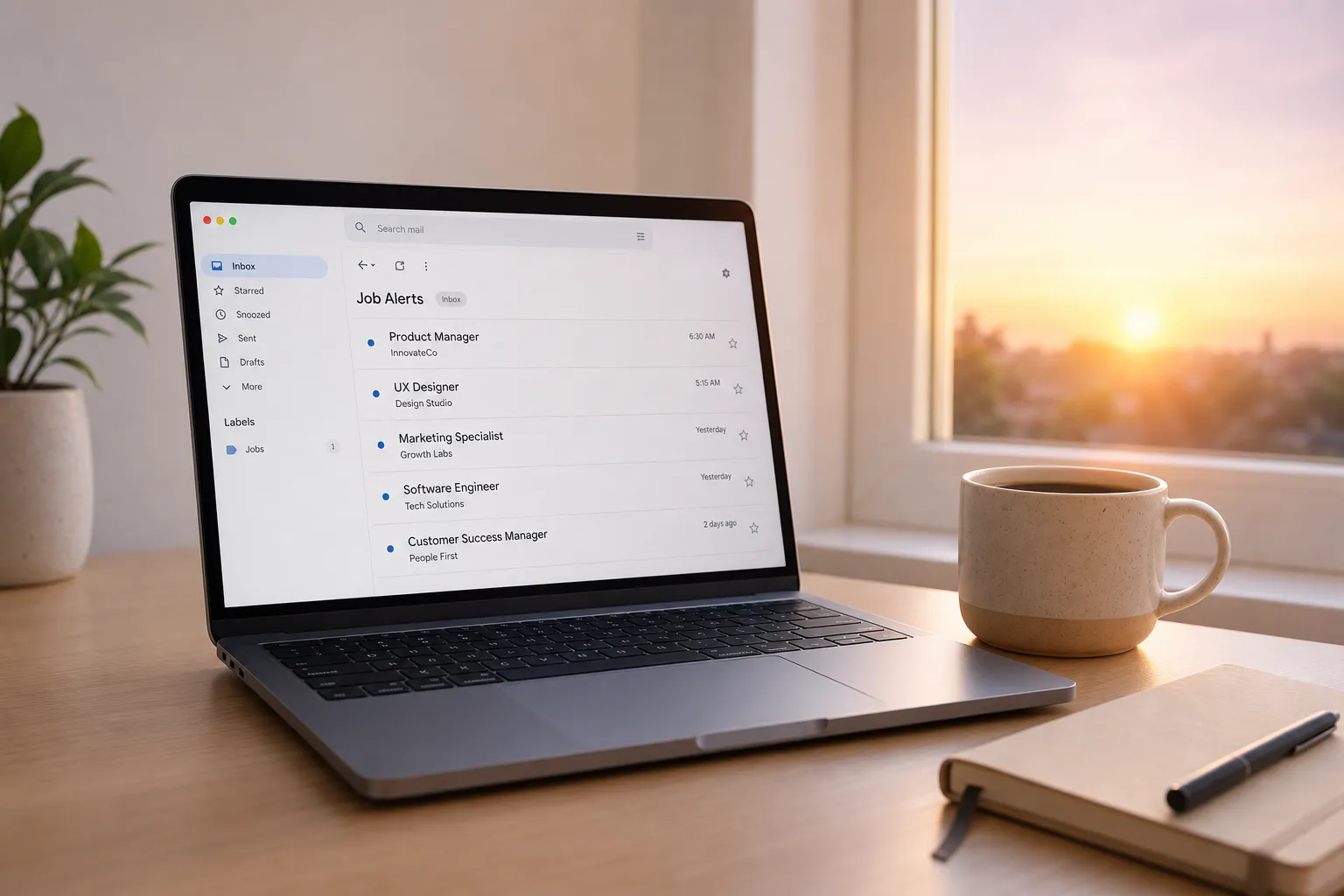
If you are qualified but getting silence, the blocker is usually timing and fit. This case study shows how a mid-level product marketer ran a 14-day sprint using hourly job alerts, quick triage, AI-tailored resumes, and proof-first follow-ups to turn 23 applications into 3 first-round interviews. You will see the exact filters, message templates, and numbers so you can copy the system.
The job seeker and the goal
Maya is a B2B SaaS product marketer with four years of experience and recent layoffs on her resume. In the three weeks before this sprint she relied on default LinkedIn alerts and ad hoc searching. She sent 12 applications, averaged 35 minutes each, and got zero recruiter screens. She was often applying a day or two after roles went live.
The goal was simple and measurable: book at least three first-round interviews in 14 days without turning the hunt into a full-time job. Constraints were strict: 45 minutes each morning, 20 minutes midday, and 30 minutes in the evening. Target roles were Product Marketing Manager or Senior PMM at Series A–D SaaS companies, US-remote or Boston hybrid.
The system: alerts, triage, tailoring
Maya set up an hourly cadence that surfaced roles fast, filtered them to the best fits, and shipped tailored applications in minutes.
1) Hourly alerts with tight filters
She configured alerts to refresh every hour across LinkedIn, company career sites, and common ATS boards. Titles included Product Marketing Manager, Senior Product Marketing, Go-to-Market, and Product Storytelling. She filtered for B2B SaaS, 25–1,000 employees, Series A–D, and US-remote or Boston hybrid. She excluded student, internship, and marketing communications roles.
Her saved search logic looked like this: product marketing OR product marketer OR go-to-market NOT communications NOT brand NOT internship. The output was a steady trickle of fresh roles instead of a single daily dump.
2) One-minute triage
She batched alerts three times a day. For each posting she checked three must-haves: scope (IC vs manager), stage fit (Series A–D), and core responsibilities (launches, positioning, enablement). Then she tagged each role:
- A: 80 percent match or higher. Recent, high-signal overlap with her wins.
- B: 60–79 percent with a clean story to bridge a gap.
- C: Interesting but low probability.
Only A and strong B roles moved forward. She also noted median applicant count when visible. If a role had under 25 applicants and was posted within two hours, it was marked A+ to prioritize immediate submission.
3) Tailored resumes in five minutes
For A roles, Maya used an AI resume builder. Process per role:
- Paste job description.
- Pick three relevant wins from her library.
- Generate a one-page resume with the target title mirrored in the header.
Formatting stayed ATS friendly: standard fonts, no tables or text boxes, 10–12 pt body, clear section headers. She mapped keywords from the posting to her bullets naturally. Example bullets:
- Led GTM for two feature launches used by 3,800 MAUs; partnered with sales to build 5 enablement assets, contributing to a 12 percent lift in win rate for target segment.
- Rebuilt positioning and messaging for workflow product, cutting time-to-first-value by 22 percent and reducing onboarding tickets by 18 percent.
For strong B roles, she repurposed the closest A resume, swapped two bullets, and updated the summary line to match the posting’s language. Filenames were consistent: Maya-Singh_PMM_Acme_Resume.pdf.
4) Cover letters that show proof
Letters were 120–180 words. Structure:
- Line 1: Mirror the role’s focus in plain English.
- Lines 2–3: One quantified outcome that matches the top requirement.
- Line 4: A link to a short proof asset.
Sample open: I love how your PMM role ties launches with enablement. In my last role, I owned two GTMs that moved adoption 19 percent in the first quarter. I can bring the same crisp positioning and field-ready content to your next release.
For one role, Maya added a 60-second product walkthrough she recorded on her Mac to show how she explains features to non-technical users. She made it fast and polished using a macOS product demo video maker with automatic zoom and pan, smooth cursor paths, styled backgrounds, and high-quality exports. The video was optional, but it gave her a concrete artifact to reference in emails and interviews.
5) Short, scheduled follow-ups
After submitting, she logged channel, date, and contact. Reminders auto-fired at day 3 and day 7 if there was no reply. Two templates she used:
Day 3: Hi [Name] — Applied on [date] for [role]. Strong overlap with your [top requirement], including [1 metric]. Here is a 60-sec sample that shows how I approach it: [link]. Happy to send more context if helpful.
Day 7: Hi [Name] — Quick check on my application for [role]. I recently shipped [result] with [team], which seems aligned with your [initiative]. If my background looks useful, I would love to confirm receipt and send a brief work sample pack.
For A roles, she also looked up the hiring manager and referenced one public initiative in a single sentence. No ask for time, just context.
Results and what changed in 14 days
Baseline before the sprint
12 applications over 3 weeks, 0 recruiter screens, 1 automated rejection, average 35 minutes per application, and most submissions 24–48 hours after posting.
Week 1
- Alerts received: 68
- A or strong B fits: 22
- Applications sent: 12
- Median time to apply after posting: 2 hours 15 minutes
- Average time per application: 12 minutes
- Responses: 3 human replies. Two recruiter screens, one request for work samples
The first interview request arrived on day 5 from a career-page posting that never hit her old daily feed. She applied 54 minutes after it went live and led her resume with a launch that mirrored the job’s first requirement.
Week 2
- Alerts received: 71
- A or strong B fits: 21
- Applications sent: 11
- Median time to apply after posting: 1 hour 38 minutes
- Responses: 5 human replies
- Interviews booked by day 14: 3 first-round screens, from one LinkedIn post and two company career sites
Two interviews landed right after polite day-3 follow-ups. For one role, the hiring manager called out the 60-second demo as helpful signal for a storytelling-heavy PMM seat.
Totals for the sprint
- Total alerts: 139
- Total applications: 23
- Human replies: 8
- Interviews: 3
- Time saved: about 7 hours versus her old process
Reply rate was 34.8 percent of submissions that got any human response. Interview rate was 13 percent of applications, up from 0 percent in the prior three weeks. The lift came from relevance and speed, not volume.
The repeatable playbook
- Create 2–3 focused alerts for top titles and your niche. Refresh hourly across LinkedIn, company sites, and ATS boards. Exclude poor fits so you do not drown in noise.
- Block three mini-sessions a day. Batch review new roles for one minute each. Tag A, B, or C. Only move A and strong B forward.
- Build a reusable win library. For each win, note problem, action, result, and numbers. Plug from this library when you tailor resumes.
- Use an AI resume builder for A roles. Mirror the job title, front-load two bullets that match the first requirement, and keep formatting ATS friendly. Rename files consistently.
- Write 150-word cover letters that mirror language in the post and add one proof link. Keep it skimmable.
- Submit within two hours of discovery when possible. Early applicants get more attention during the first shortlist pass.
- Log every submission. Follow up on day 3 and day 7 with one sentence on fit, one sentence with a metric or artifact, and a direct ask to confirm receipt.
- Review weekly. Track where replies come from by channel and role type. Double down on sources and patterns that produce human callbacks.
Why it worked
Speed moved her to the top of the stack
Many recruiters shortlist within the first day. Hourly alerts meant she was often among the first 20 applicants instead of the 120th. That single shift improved open rates and reply odds.
Fit-first targeting increased quality without more hours
Skipping C-fit roles freed time to make A applications sharper. The resume led with outcomes the posting cared about, which helped her clear screening questions fast.
Signals matched how ATS and humans scan
Mirrored titles, relevant keywords, and quantified bullets placed evidence where screeners look first. Clean formatting kept parsers from mangling text.
Proof beat promises
The short demo showed how she explains product value. It turned generic claims into something a recruiter and hiring manager could quickly evaluate.
Predictable follow-ups nudged stalled threads
Two short reminders at day 3 and day 7 generated quick yes or no responses without burning goodwill.
Key takeaways
- Hourly job alerts shift timing in your favor and widen coverage beyond a single platform.
- Score roles fast, skip low-fit options, and reinvest time in A-grade applications.
- AI tailoring makes resumes and letters specific in minutes while staying ATS friendly.
- Submit within hours, not days. Early is often the difference between a reply and a black hole.
- Short, proof-driven follow-ups convert silent interest into scheduled screens.
- Lead with role-aligned outcomes up top. Keep everything else simple and scannable.
If your pipeline has stalled, run a two-week sprint like this. Keep the focus narrow, operate on an hourly rhythm, and let AI handle the repetitive writing. You will spend less time guessing and more time talking to real people.