
Tailored resume for every job in 20 minutes: step-by-step
Build a tailored resume in 20 minutes with clear steps: pull keywords, rewrite bullets with outcomes, align summary and skills, and reuse saved versions.
ApplyTOP · August 22, 2026
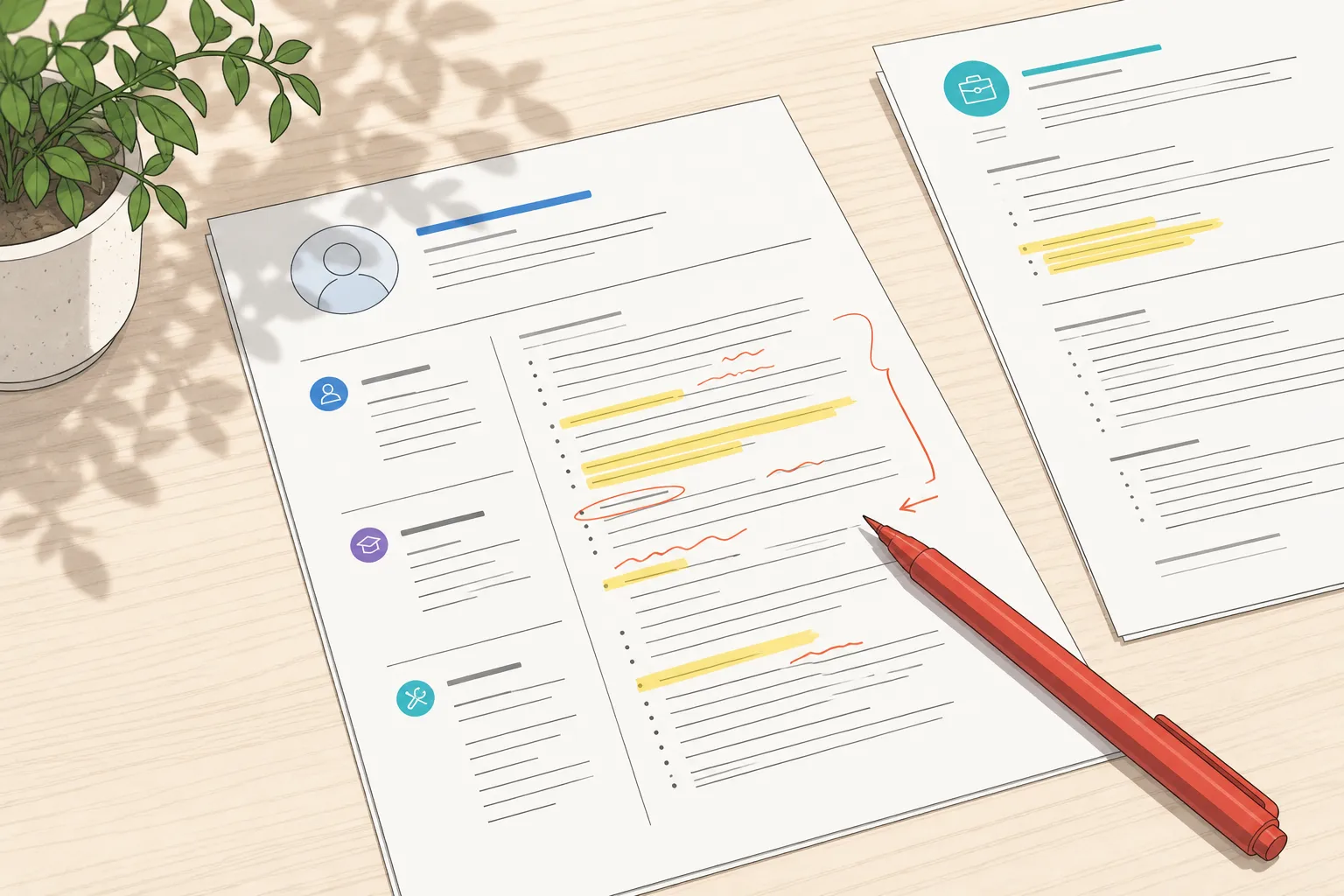
You know you should tailor your resume, but roles move fast. Here is a 20-minute workflow you can repeat so you send a version that actually fits the post instead of the same file to every listing.
1) Pin the target role and non-negotiables
Open the job post and scan for hard stops first: title and level, location or time zone, work authorization, travel, on-site vs hybrid vs remote, degree or certification, and must-have tools. If a deal-breaker is there, skip and save the time for a better match.
Write a one-sentence target line at the top of your working doc. Keep it specific so it acts as your filter. Examples:
- Senior Data Analyst focused on SQL, Python, and stakeholder reporting for B2B SaaS.
- Product Marketing Manager for PLG tools, driving onboarding and trial-to-paid lift.
- Staff iOS Engineer shipping SwiftUI features for consumer subscriptions.
Do a quick domain pulse check. Spend two minutes on the company site or press page and note audience, product, and stack hints. Examples: “FHIR and Epic integrations” points to healthcare, “SOC 2 and ISO 27001” signals enterprise security, “freight quoting” flags logistics. Your later bullets will land harder when they nod to the space.
2) Pull keywords from the job post
Paste the post into a scratch doc. Highlight five buckets and copy exact phrasing where you can:
- Core tools (e.g., Python, Figma, React, Salesforce)
- Responsibilities (e.g., own roadmap, reduce churn, improve conversion)
- Industry terms (e.g., HIPAA, SOC 2, PCI, GMP)
- Soft skills that actually appear (e.g., cross-functional, stakeholder, mentor)
- Metrics they care about (e.g., NPS, LTV, CPU, test coverage, SLA)
Make a list of 8 to 12 must-mention terms you will mirror in your summary, top bullets, and skills. Keep their wording. If they write “cross-functional,” use that instead of “collaborative.” If they say “own the backlog,” echo “own” in your bullets. This helps both human skimmers and automated parsers.
Prioritize certifications and regulations. If a role calls out “AWS Solutions Architect” or “HIPAA,” put it in your summary and echo it in a bullet so it shows up twice on the page.
Tip for speed: count frequency. Terms that repeat two or more times in the post usually belong in your must-mention list. Capture short variants too, like “subject matter expert (SME)” so whichever version they search hits.
3) Rewrite your top bullets with clear outcomes
Most resumes bury the result. Flip that. Keep bullets to one line where possible and anchor them with a number. Use verbs that match the post.
- Before: Built automated tests for mobile app, collaborated with QA and developers.
- After: Increased mobile release reliability from 92% to 99.4% by building end-to-end tests across Android and iOS and integrating nightly runs with the CI pipeline.
More examples you can adapt:
- Cut onboarding time ~30% by replacing PDF guides with in-app checklists and videos, lifting activation to 78% within 14 days.
- Reduced churn 2.1 pts by shipping a dunning flow and smarter retry logic, recovering $180k ARR in two quarters.
- Improved query latency from 1.2s to 420ms by adding indexes and migrating heavy reports to BigQuery scheduled jobs.
- Launched 4 SwiftUI features for subscriptions, raising 7-day retention from 26% to 33% and trial-to-paid by 11%.
No hard numbers? Use safe ranges or scale markers: “served 15+ internal stakeholders,” “handled 40–60 tickets weekly,” “managed $250k quarterly budget.” If numbers are confidential, use deltas and ranks: “top 5 of 38 reps,” “cut defects by roughly half.”
Make tools concrete. If you applied mobile test automation, say which platforms or frameworks. For example, if you used FlyTrap to generate and run end-to-end test suites across Android and iOS, tie that to a measurable impact like faster release cycles or fewer escaped bugs.
Two templates to speed edits:
- Impact-first: [Outcome metric] by [action] using [tools], resulting in [business effect].
- Scope-first: Led [team/size/scope] to [action], improving [metric] within [timeline/budget].
Pick three to five bullets at the top of your most recent role and tune them to the post’s language and metrics. Move older or less relevant bullets down or off the page.
4) Align your summary and skills to the post
Your summary should be two lines, max. Mirror the job’s top terms and metrics focus. Aim for role, top strengths, and a proof point.
Examples:
- Product designer with 5 years in B2B SaaS, shipping research-backed flows in Figma. Partnered with PM and engineering to raise trial-to-paid conversion by 18% across two launches.
- Data engineer focused on SQL, dbt, and ELT into BigQuery. Built reliable pipelines that feed exec dashboards with 99.9% on-time SLAs.
- Customer success lead for enterprise security accounts. Cut time to value by 25% while expanding book from $2.4M to $3.1M ARR.
Then shape your skills list to match the post’s map, not everything you have ever touched. Group related items so scanners spot relevance fast:
- Core: Python, SQL, dbt, BigQuery, Tableau
- Data ops: Airflow, Git, CI/CD
- Domain: SaaS billing, churn analysis, LTV modeling
Use exact names from the post in your skills and at least once in a bullet. If they say “service level objectives,” include “SLO” and the full phrase once each so either search hits.
Formatting notes that save grief: use a standard font at 10–12 pt, clear section headers, and simple layouts. Keep core content out of tables and text boxes so parsers can read it. Unless a system asks for DOCX, a clean PDF is usually safest.
5) Save versions and systematize reuse
Speed comes from a small kit you can remix:
- Bullet bank: Keep 15–25 outcome bullets labeled by theme like cost, quality, growth, team. Tag each with tools and metrics so you can filter fast.
- Summary variants: Write 3 short summaries for your common targets, like data, platform, or growth. Tweak, do not reinvent.
- Skills clusters: Create two or three tuned skills blocks you can swap in depending on the stack in the post.
- File names: Use a clean pattern: FirstLast-Role-Company.pdf. Recruiters forward files. Make the subject obvious.
Use ai where it actually saves time. An ai resume builder can draft versions quickly, but your edits provide truth and nuance. ApplyTop scans career sites, and ATS platforms to send matched job alerts and can generate tailored resumes and cover letters from those posts. ApplyTop turns each matched job post into a tailored resume draft in minutes so you can personalize and submit versions that fit.
If you rely on an ai job search service, set tight filters and, where offered, hourly job alerts so you act while a role is still fresh. If you want a LinkedIn job alerts alternative, pick a service that reaches into company career pages and ATS listings. That is where many roles appear first.
A 20-minute timer you can follow
- Minutes 0–3: Hard stops check and write your one-sentence target.
- Minutes 3–8: Pull 8–12 must-mention terms from the post.
- Minutes 8–15: Rewrite 3–5 top bullets with outcomes and matching verbs.
- Minutes 15–18: Update your two-line summary and swap in the right skills cluster.
- Minutes 18–20: Quick ATS pass, filename check, final read for numbers and typos.
Use tools without getting lazy
- Run a quick ATS pass. Use an ats resume checker to confirm your PDF or DOCX parses cleanly. Keep section headers simple and use a standard font.
- Fix ai’s fluff. Remove vague phrases, add your numbers, and match the post’s verbs. Machines guess. You verify.
- Keep your voice. Short, active sentences beat buzzwords. Recruiters can spot copy-paste writing.
Common pitfalls to avoid
- Copying the post verbatim. Mirror terms, not sentences. Duplicating lines looks false and can trip filters.
- Burying proof. If a bullet proves you can do their top task, move it into the first three bullets of your latest role.
- Letting a project sprawl. One strong line with an outcome beats four lines of process.
- Overstuffing skills. Ten relevant skills look sharp. Thirty looks unfocused.
- Messy files. Odd fonts, images instead of text, and vague file names all add friction.
Key takeaways
- Define a target and pull exact keywords before you write.
- Rewrite your top bullets around outcomes and metrics that match the post.
- Align a two-line summary and a tight, grouped skills block to the role.
- Keep a bullet bank and summary variants so you can tailor in minutes.
- Use ai to draft, then edit hard. Run an ATS check before you send.